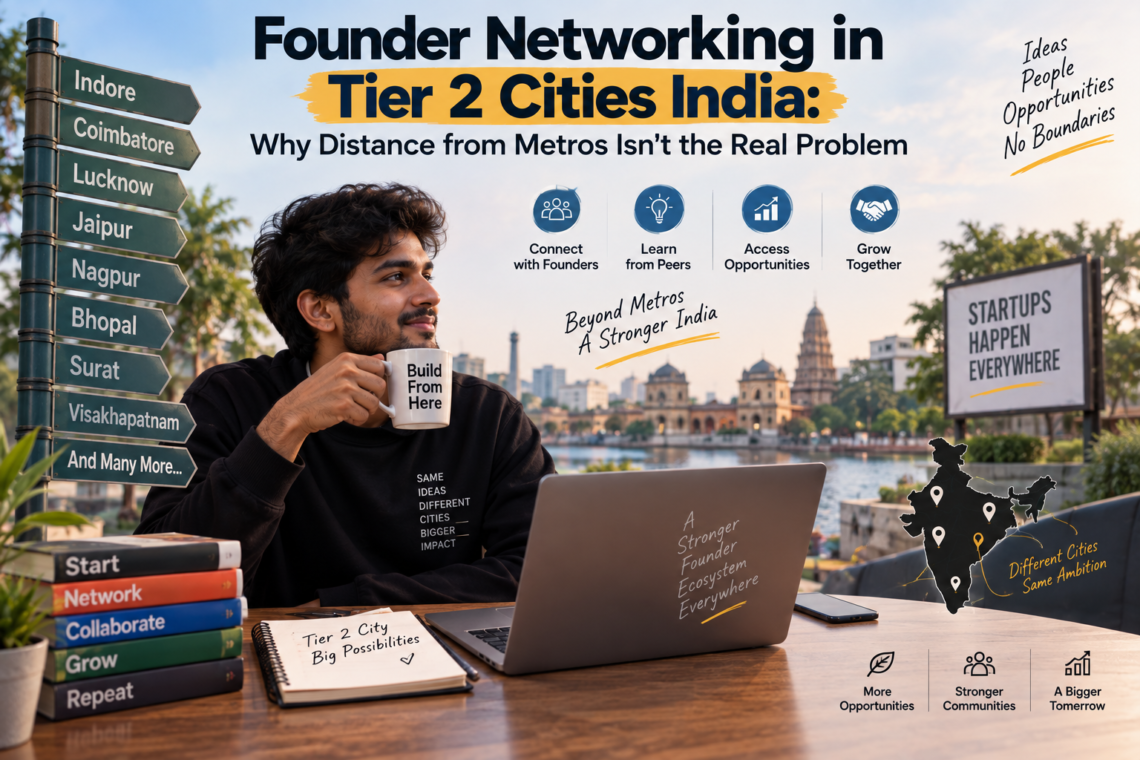
There’s a quiet assumption in India’s startup world that anything worth building happens in Bangalore, Mumbai, or Delhi. Founders in Indore, Coimbatore, Lucknow, or Jaipur often internalize this — treating their city as a handicap rather than a starting point. But the real gap isn’t geography. It’s networking access, and that’s fixable.
Why Tier 2 Founders Feel Cut Off
Metro cities concentrate almost everything a founder needs — investors, mentors, co-founders, service providers, and peer founders who’ve already solved the exact problem you’re stuck on. In a tier 2 city, that density simply doesn’t exist yet. So the challenges show up in specific, practical ways:
- Fewer in-person founder meetups to walk into
- Investors defaulting to founders they can meet for coffee, which usually means metro-based
- Smaller local talent pools for specialized hires
- A sense of being “behind” simply because visible success stories cluster elsewhere
- Having to travel for almost every meaningful founder event
None of this reflects the quality of ideas coming out of tier 2 cities — plenty of strong, profitable businesses are being built there right now. It reflects a networking infrastructure gap, which is a very different problem to solve.
What Actually Changes the Equation
Online-first founder communities. The biggest shift of the last few years is that founder networking no longer requires physical proximity to a metro. Structured online communities let a founder in Nagpur access the same peer conversations, accountability partners, and mentor introductions as someone in Bangalore — often faster, because there’s no commute involved.
Hybrid meetups. Communities that host occasional in-person events in multiple cities, not just metros, are worth prioritizing. A quarterly meetup in your own city beats a monthly one you have to fly to. Women founders can also explore dedicated startup founder communities designed to provide peer support, networking, and mentorship.
Remote-first investor relationships. More investors are comfortable evaluating and backing founders over video calls than five years ago, especially once there’s traction to point to. The barrier has dropped more than most founders realize.
Local business associations and chambers of commerce. Every reasonably sized Indian city has some version of this. It’s not startup-specific, but it’s a real, existing network worth tapping for vendor relationships, early customers, and local credibility.
Founders visiting your city, not just you visiting theirs. As more founders build outside metros, communities are starting to route events through tier 2 cities specifically. Being present and vocal in your local scene increases the odds your city becomes a stop on that circuit.
The Advantage Tier 2 Founders Actually Have
Lower costs mean longer runway on the same capital. Less competition for local talent and customers often means faster traction in your specific market. And tier 2 cities are frequently underserved by the exact products metro-first startups build — a genuine market opportunity, not a consolation prize.
The founders who do well outside metros tend to treat their city as an advantage in cost and market timing, while actively building their network elsewhere rather than waiting for it to arrive locally.
Where YBF Fits In
YBF (yourbestfrnd.com) is built around exactly this gap — connecting founders regardless of city through structured pods and accountability matches, with offline meetups already running in cities like Hyderabad and Mumbai and expanding reach beyond the usual metro circuit. For a founder in a tier 2 city, it means access to the same peer network a Bangalore founder gets, without needing to relocate to get it.
Being in a tier 2 city in India isn’t the obstacle it used to be. The founders falling behind aren’t the ones outside metros — they’re the ones who let distance stop them from building a network at all.