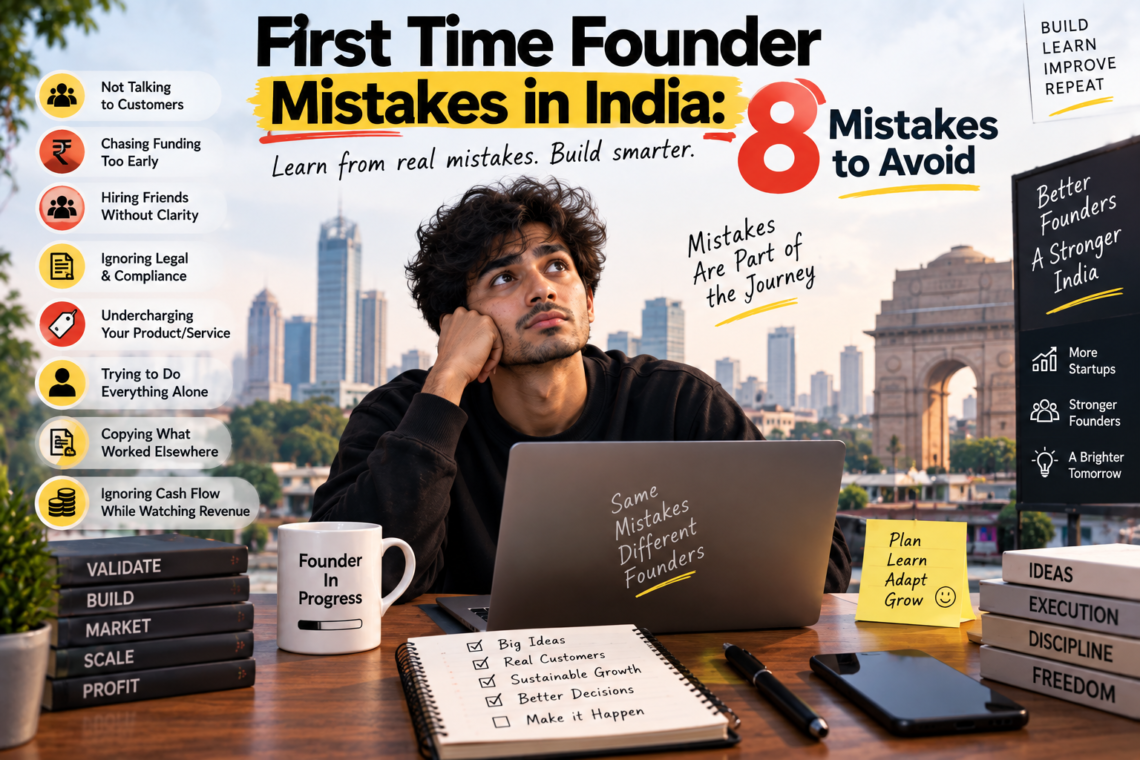
Almost every founder who’s been at it for a few years has a list of things they’d do differently. The frustrating part is that most of those mistakes weren’t complicated or unusual — they were the same handful of errors first-time founders in India keep making, year after year, because nobody sat them down and said “don’t do this.”
Here’s that conversation, condensed.
1. Building for months before talking to a single customer
This is the big one. A lot of first-time founders spend six months perfecting a product in isolation, convinced that once it’s ready, people will obviously want it. Then launch day comes and nothing happens.
The fix isn’t glamorous — talk to twenty potential customers before you write a line of code. Ask what they currently do about the problem, what they’ve tried, and whether they’d pay for something better. If ten conversations in nobody seems bothered by the problem you’re solving, that’s information worth having early rather than after burning your savings.
2. Chasing funding before there’s anything to fund
Somewhere along the way, raising money became the marker of success instead of building something people pay for. First-time founders in India often start pitching investors at the idea stage, get rejected repeatedly, and conclude their idea is bad — when really they just approached the wrong stage of the journey.
Revenue, even small revenue, changes every investor conversation. Ten paying customers is a stronger pitch than a fifty-slide deck with no traction behind it.
3. Hiring friends because it feels safer
It feels like the low-risk move. You know them, you trust them, and there’s no awkward interview process. But hiring a friend who isn’t right for the role creates a problem with no clean exit — you can’t performance-manage someone you’ve known for ten years without damaging the friendship, so you tolerate underperformance far longer than you should.
If you do bring friends in, define roles, expectations, and equity in writing on day one. The conversation is uncomfortable now and far more uncomfortable later.
4. Skipping the boring legal and compliance stuff
Registration structure, founder agreements, equity splits, GST, contracts with early clients — none of it is fun, and plenty of Indian founders push it to “later.” Then a co-founder leaves, or a client disputes payment, or an investor asks for clean documentation during due diligence, and suddenly “later” is a very expensive problem.
Get the founder agreement and equity split documented before anything goes wrong. Verbal understanding between friends has a poor track record once real money is involved.
5. Undercharging out of fear
First-time founders in India routinely price too low, assuming cheap is how you win customers. What actually happens is you attract price-sensitive clients who demand the most, respect your work the least, and leave the moment someone cheaper shows up. Meanwhile your margins can’t support hiring or growth.
Price for the value you deliver, not for what feels safe to ask for. Losing a few price-sensitive prospects is usually a good outcome.
6. Trying to do everything alone
Especially for solo founders, this one’s almost automatic. You handle product, sales, marketing, support, accounting — and slowly become a bottleneck for your own company. Worse, with no peer group around, there’s nobody to tell you when you’re making an obvious mistake or spiralling over a normal setback.
Having a founder accountability partner can give solo founders the peer support and accountability they need to stay focused and make better decisions..
7. Copying what worked somewhere else
A growth tactic that worked for a US SaaS company or a Bangalore-based D2C brand doesn’t automatically translate to your market, your city, or your customer. India isn’t one market — buying behaviour in a metro is different from a tier-2 city, and what converts in English might not convert in a regional language.
Test small before committing your budget to someone else’s playbook.
8. Ignoring cash flow while watching revenue
Revenue looks great on a spreadsheet. Cash in the bank is what keeps the company alive. A lot of first-time founders celebrate a big client win, then discover the payment terms are 90 days while salaries are due in 30. Track runway weekly, not quarterly.
Where YBF fits in
A lot of these mistakes are avoidable simply by having other founders around — people who’ve already made the error and can flag it before you repeat it. That’s the whole point of YBF (yourbestfrnd.com): small founder pods, accountability partners, and offline meetups in cities like Hyderabad and Mumbai where the conversations are honest rather than performative.
Founders based in Mumbai can also explore this founder community in Mumbai to connect with other entrepreneurs and discover local networking opportunities.