LinkedIn is probably where most founders start when they think about networking. It’s familiar, it’s free, and everyone’s already on it. But if you’ve spent any real time there, you’ve probably noticed something: tons of connections, very few actual relationships. That’s the gap a dedicated founder community like YBF is built to close.
What LinkedIn Is Actually Good For
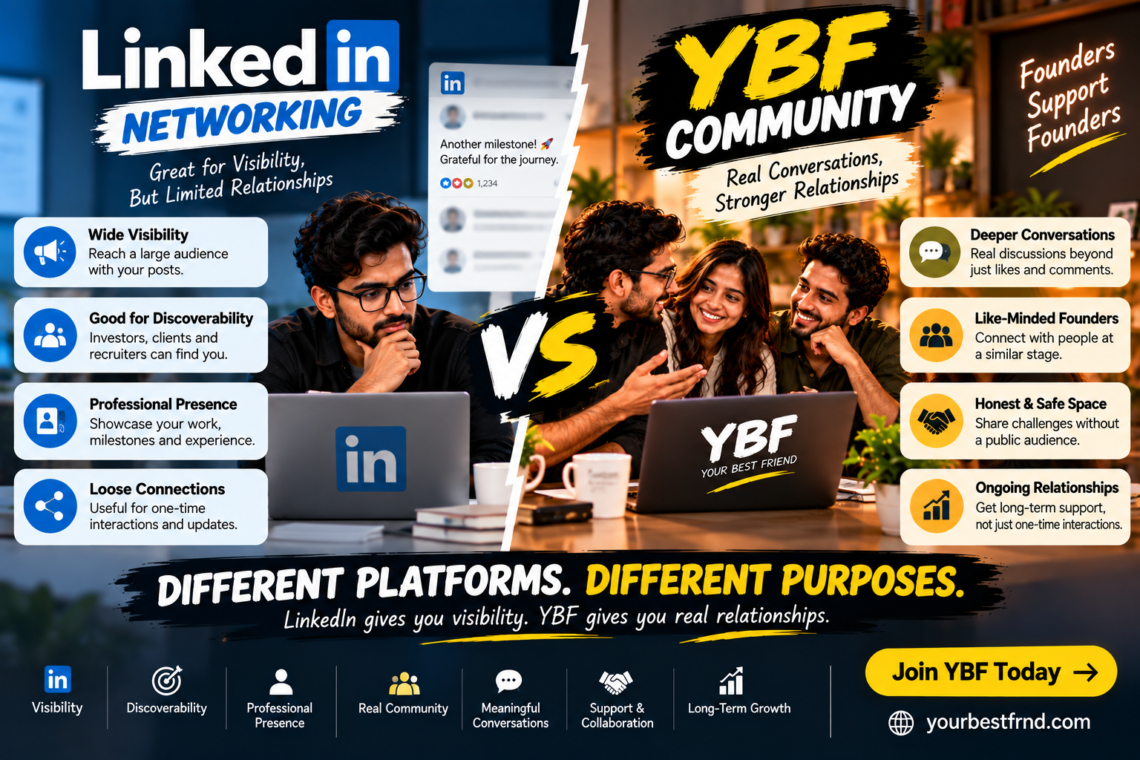
LinkedIn works well for visibility. Posting about a launch, a milestone, or a lesson learned can reach a wide audience quickly. It’s useful for discoverability too, recruiters, investors, and potential clients often check LinkedIn first. And it’s a reasonable place to maintain loose, professional connections with people you’ve met once or twice.
None of that is bad. It’s just a different kind of value than what most founders actually need day to day.
Where LinkedIn Falls Short for Founders
The core problem with LinkedIn as a support system is that it’s built for broadcasting, not conversation. You post, people react, maybe a few comment, and then everyone moves on. Direct messages often go unanswered, especially from people you don’t already know. And the platform rewards performance, polished wins, not the messy, uncertain reality of actually running a company.
If you’re dealing with a genuine problem, a co-founder conflict, a pricing decision you’re unsure about, a tough call on letting someone go, LinkedIn isn’t really built for that conversation. Posting about it publicly feels exposed, and DMing a stranger rarely gets a thoughtful response.
What a Dedicated Founder Community Offers Instead
Communities like YBF are structured around the opposite principle: ongoing, two-way conversation among people at a similar stage, not one-way broadcasting to a wide audience.
Context that doesn’t need re-explaining. On LinkedIn, everyone’s a stranger until proven otherwise. In a founder community, the baseline understanding is already there, people get what you’re dealing with without a long backstory.
Honesty without an audience. It’s a lot easier to say “I’m stuck and not sure what to do” in a smaller, trusted group than in a public post seen by current and former colleagues, clients, and competitors.
Reciprocal relationships. LinkedIn connections are often one-time interactions. Community relationships tend to build over repeated conversations, where today you’re asking for help and next month you’re the one giving it.
Smaller, more intentional space. A community with genuine participation feels fundamentally different from a feed with millions of users competing for attention. Conversations go deeper because there’s less noise to compete with.
They’re Not Really Competing, Though
It’s worth saying clearly: this isn’t really LinkedIn versus a founder community in a strict either-or sense. They solve different problems. LinkedIn is useful for visibility and loose professional presence. A founder community is where the real, ongoing support actually happens. Most founders end up using both, just for very different purposes.
A Simple Way to Tell the Difference
Ask where you’d actually go if you needed honest advice on something stressful today. If the honest answer is “I’d post about it and hope someone relevant sees it,” that’s a sign you’re missing the second piece. A community fills exactly that gap.
Looking for the Kind of Support LinkedIn Doesn’t Offer?
YBF (Your Best Friend) connects Indian founders in a space built for real, ongoing conversation, not just another feed to scroll through. Visit yourbestfrnd.com to learn more and join.