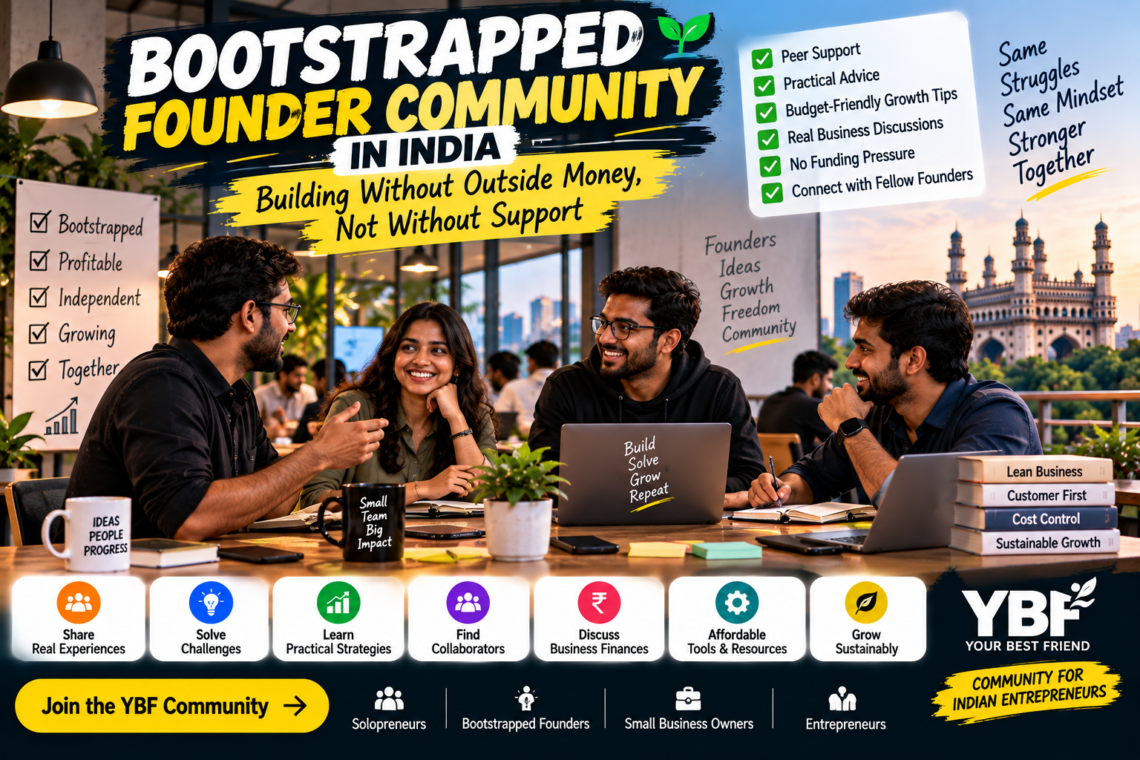
Most startup advice assumes you’re raising money. Pitch decks, term sheets, demo days. But a large share of Indian founders never take a rupee of outside capital. They fund the business from savings, early customers and a lot of patience. If that’s you, a bootstrapped founder community in India can give you something investors usually can’t: advice from people who run on the same tight budget.
Why Bootstrappers Need Their Own Circle
Funded founders talk about runway in quarters and hiring in batches. A bootstrapped founder thinks about whether this month’s client payment will arrive before the rent is due. The questions are different:
- Is it worth paying for that tool, or can I do it manually for now?
- Should I take a low-paying client to keep cash flowing?
- When can I pay myself, and how much?
- Do I really need to hire, or can I stretch another quarter?
A founder who has never worried about cash tends to give advice that sounds good and costs too much. Someone who has stretched ₹50,000 over a bad month gives answers you can actually use.
What You Get From Other Bootstrappers
Cheap, practical shortcuts. Which free tool is good enough, which freelancer is worth the money, how to negotiate with a vendor when you have no leverage.
Honest talk about money. In a community of bootstrappers, nobody pretends. People share what they charge, how they price and where they went wrong, without the polished version.
Permission to grow slowly. Startup culture pushes the idea that if you’re not doubling every year, something is wrong. Bootstrappers know steady, profitable growth is a perfectly good goal.
Support during cash crunches. Late payments happen. Having people who’ve been there, and who may send a lead your way, makes a bad month easier to survive.
Pressure-free decisions. With no investors to answer to, you can choose what’s right for the business. A peer group helps you think those choices through.
Mistakes a Community Can Help You Avoid
- Underpricing out of fear of losing a client
- Spending on tools and branding before the first paying customers
- Hiring too early, or too late
- Mixing personal and business money without clear rules
- Staying with a bad client because the invoice is overdue and you’re stuck
Most of these feel obvious afterwards. Hearing a peer describe them beforehand is a lot cheaper.
How to Pick the Right Community
- Members who run real businesses. Revenue, however small, matters more than an impressive pitch.
- Open conversations about money. If nobody shares numbers or pricing, the advice will stay vague.
- No funding-obsessed culture. Groups that treat raising money as the only success can leave bootstrappers feeling behind.
- Active, not just large. Check whether people reply to each other this week.
- No hard selling. Courses and “mastermind” upsells in every second message are a warning sign.
Getting More Out of It
Be specific about what you’re dealing with. “How do I get clients?” brings generic replies. “I run a three-person design studio in Nagpur and my last two clients paid late, how do I tighten payment terms?” brings real ones.
Share your own numbers when you’re comfortable, too. Others are more willing to open up once someone goes first.
A Fair Word on Bootstrapping
It isn’t better or worse than raising funds, just different. It means slower early growth and more personal risk, but also more control. A good community helps you weigh that trade-off honestly, and, if you ever decide to raise money, connects you with people who’ve done it.
Find Your Fellow Builders
YBF (Your Best Friend) is a community for Indian entrepreneurs, including bootstrapped founders, who want honest conversation and support that fits real-world budgets. Visit yourbestfrnd.com to learn more and join.