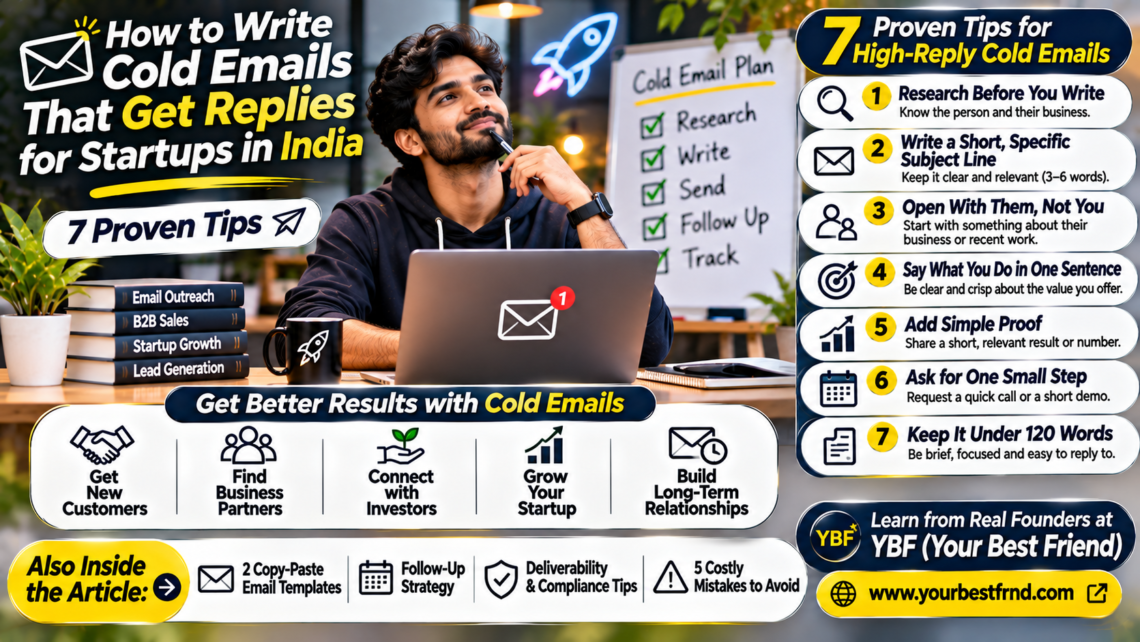
Most cold emails die in silence. Too long, too vague, too much about the sender and too little about the reader. Yet a short, well-aimed email can open doors to customers, partners and investors without spending a rupee on ads. If you want to know how to write cold emails that get replies for startups in India, the secret isn’t clever tricks. It’s respect for the reader’s time.
Why Cold Email Still Works for Startups
Inboxes are crowded, but most messages are lazy. A clear, relevant email stands out. It costs almost nothing, scales slowly and teaches you exactly what customers care about.
It also works well in India for B2B sales, where decision-makers read email even if they ignore calls.
7 Proven Tips
1. Research Before You Write
Spend two minutes on every recipient. Read their website, LinkedIn or a recent post. One accurate detail proves you’re writing to a person, not a list.
2. Write a Short, Specific Subject Line
Aim for 3 to 6 words. Specific beats clever. “Quick question about your clinic bookings” works better than “Amazing opportunity inside!” Avoid caps, exclamation marks and spammy words.
3. Open With Them, Not You
Skip “I hope you’re doing well” and long introductions. Start with something relevant: “Saw your new Hyderabad branch opened last month.”
4. Say What You Do in One Sentence
“We help small clinics cut missed appointments with automatic reminders.” That’s it. If you need three sentences, the idea isn’t clear yet.
5. Add Simple Proof
One line of evidence builds trust: a customer result, a pilot or a relevant number. “Three clinics in Pune reduced no-shows within a month.” Keep it honest and specific.
6. Ask for One Small Step
Don’t ask for an hour. Ask a simple question: “Worth a 10-minute call this week?” or “Should I send a short demo video?” A small ask is easier to say yes to.
7. Keep It Under 120 Words
Short emails get read on phones, between meetings. Cut every sentence that doesn’t help the reader decide.
2 Copy-Paste Templates
Template 1: Customer Outreach
Subject: Quick question about [their business]
Hi [Name],
Saw [specific detail about their business]. We help [type of business] [achieve specific result] without [common pain].
[One-line proof, such as: “Three clinics in Pune cut no-shows within a month.”]
Worth a 10-minute call this week? Happy to send a short demo first if you prefer.
Thanks,
[Your name]
[Company, phone]
Template 2: Partnership or Introduction
Subject: Idea for [their company] and [your company]
Hi [Name],
I follow [their company] and liked [specific thing]. We work with [your audience], and I think there’s a way to help your customers with [benefit].
Would you be open to a quick chat about a small pilot?
Thanks,
[Your name]
Follow Up Without Being Annoying
Most replies come after the second or third message. A simple cadence:
- Day 3: A short nudge: “Just checking this didn’t get buried.”
- Day 7: Add value, such as a useful tip or a short case study.
- Day 14: A polite last note: “I’ll close this loop, but happy to help later.”
Stop after three or four messages. Persistence is good. Pestering is not.
Timing and Practical Details
- Best times: Weekday mornings, especially Tuesday to Thursday, often work well. Test your own audience.
- Avoid festival weeks: People are away, and inboxes pile up.
- Use a professional address: A company domain looks far more trustworthy than a free email account.
- Keep formatting simple: Plain text, no heavy images, minimal links.
- Skip attachments: They can trigger spam filters. Share a link instead.
Protect Your Deliverability
If your emails land in spam, nobody reads them. Use your own domain, set up the basic email authentication records your provider recommends and warm up new accounts slowly instead of blasting hundreds on day one. Avoid buying email lists. Bought lists bring bounces, complaints and damaged reputation.
Stay on the Right Side of the Rules
Cold email involves personal data and consent. Be honest about who you are, include an easy way to opt out and respect unsubscribe requests immediately. India’s data protection law and your email provider’s policies can apply to how you collect and use contact details, so check current rules with a qualified adviser. This article is general information, not legal advice.
5 Costly Mistakes to Avoid
- Sending the same template to everyone. Readers can smell it instantly.
- Writing a wall of text. Long emails get skipped.
- Making vague promises. “We’ll boost your revenue” means nothing.
- Asking for too much. A big ask scares people off.
- Giving up after one email. Most replies come from follow-ups.
Track and Improve
Keep a simple sheet with the number of emails sent, replies, positive replies and meetings booked. Test one change at a time, such as a new subject line or a shorter opening. After 50 emails, you’ll know what’s working.
Learn From Founders Who’ve Done It
Other founders can share which email styles worked in their sector. YBF (Your Best Friend) is a community for Indian entrepreneurs where founders swap honest, practical advice. You can also find more guides on our resource page.
Final Thought
Knowing how to write cold emails that get replies for startups in India comes down to respect: short, specific, relevant and easy to answer. Research your reader, make one small ask, follow up kindly and keep improving. Do that, and your inbox will start to fill with real conversations.