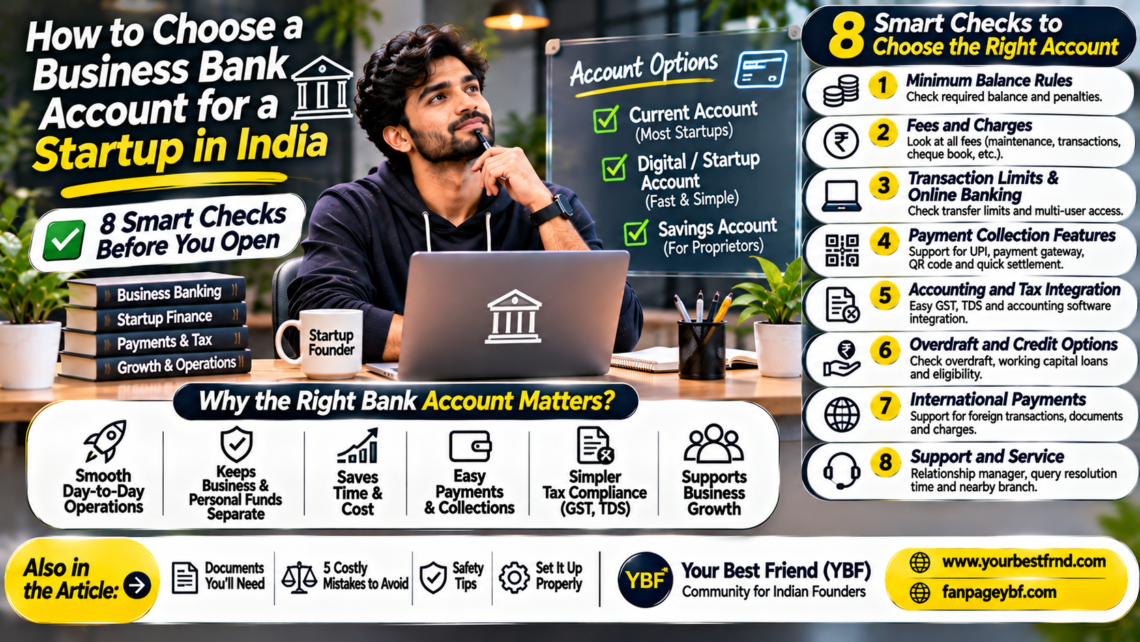
The wrong bank account quietly drains a young company. Hidden fees, balance penalties, slow support and missing features add up fast. The right one saves hours every week and keeps your money organised. If you’re working out how to choose a business bank account for a startup in India, a few simple checks before you sign can prevent months of frustration.
This is general guidance, not financial advice. Fees and rules vary by bank and change often, so confirm details directly with the bank.
Why the Right Account Matters
Your business account handles salaries, vendor payments, customer receipts and tax payments. Every delay or hidden charge creates friction. A good account becomes invisible. A poor one becomes a daily headache.
Keeping business money in a separate account also protects you from legal and tax confusion later.
What Type of Account Do You Need?
Current Account
The standard choice for companies. It’s designed for frequent transactions, higher limits and business use. Most registered companies need a current account in the company’s name.
Digital or Startup-Focused Accounts
Several banks and fintech platforms offer app-based accounts with quick onboarding, low paperwork and built-in tools. Some work through partner banks, so check who actually holds the money.
Savings Account for Proprietors
Some sole proprietors use personal-style accounts, but this can blur business and personal finances. Check what your structure allows and ask your accountant.
8 Smart Checks Before You Open an Account
1. Minimum Balance Rules
Many accounts require a minimum average balance, with penalties if you fall short. In the early months, when cash is tight, this can sting. Ask whether a zero-balance or low-balance option exists.
2. Fees and Charges
Ask for the full list: account maintenance, transaction fees, cheque book charges, cash handling, SMS alerts, statement fees and charges for failed payments. Read the fine print.
3. Transaction Limits and Online Banking
Check daily limits for transfers, UPI and online payments. Look for good online banking with multiple users, approval levels and easy downloads of statements.
4. Payment Collection Features
If you receive payments from customers, ask about UPI collections, payment gateway support, QR codes and how quickly money settles into the account.
5. Accounting and Tax Integration
Check whether the account connects to accounting software and supports easy payment of GST, TDS and other taxes online. This saves your accountant hours.
6. Overdraft and Credit Options
You may not need credit today, but you might next year. Ask about overdraft limits, working capital loans and how they assess young businesses.
7. International Payments
If you serve overseas customers or pay foreign vendors, ask whether the bank handles international transfers, what documents they need and what charges apply.
8. Support and Service
Is there a dedicated relationship manager? How fast are queries resolved? Is there a nearby branch? Support matters most when something goes wrong.
Documents You’ll Usually Need
Requirements vary, but typically include:
- Certificate of incorporation or registration proof
- Company PAN
- Memorandum and articles, or the partnership or LLP agreement
- Board resolution authorising the account and signatories
- Identity and address proof for directors or partners
- GST registration, if applicable
- Proof of the registered office address
Ask your bank for an exact checklist before you visit, to avoid repeat trips.
Compare at Least Three Options
Shortlist one large traditional bank, one smaller or private bank and one digital option. Compare them on the eight checks above. Create a simple table and score each from 1 to 5. The cheapest account isn’t always best, and the most feature-rich isn’t always necessary.
Think About Safety
Check how the bank protects your money and your login. Use strong passwords, two-factor authentication and limit who has access. Also understand deposit insurance rules, which cover deposits up to a set limit per depositor per bank. If your balances are large, consider spreading funds across banks and confirm the current limit with the bank.
5 Costly Mistakes to Avoid
- Choosing only because a friend recommended it. Their needs may differ from yours.
- Ignoring minimum balance penalties. They can cost thousands in a lean year.
- Mixing personal and business funds. It complicates taxes and audits.
- Giving everyone full access. Set sensible roles and approval limits.
- Skipping the fee list. Small charges add up over twelve months.
Set It Up Properly From Day One
Once your account is open, assign clear roles. Decide who can initiate payments and who approves them. Set up alerts for large transactions. Reconcile your statement monthly. Keep all receipts and invoices organised. Good habits in month one prevent mess in month twelve.
Learn From Founders Who’ve Done It
Other founders can tell you which banks were smooth and which were frustrating. YBF (Your Best Friend) is a community for Indian entrepreneurs where founders swap honest, practical advice. You can also find more guides on our resource page.
Final Thought
Knowing how to choose a business bank account for a startup in India saves money, time and stress. Compare fees and balance rules, check payment and tax features, think about international needs and judge the quality of support. Choose carefully now, and your bank will quietly work in your favour for years.