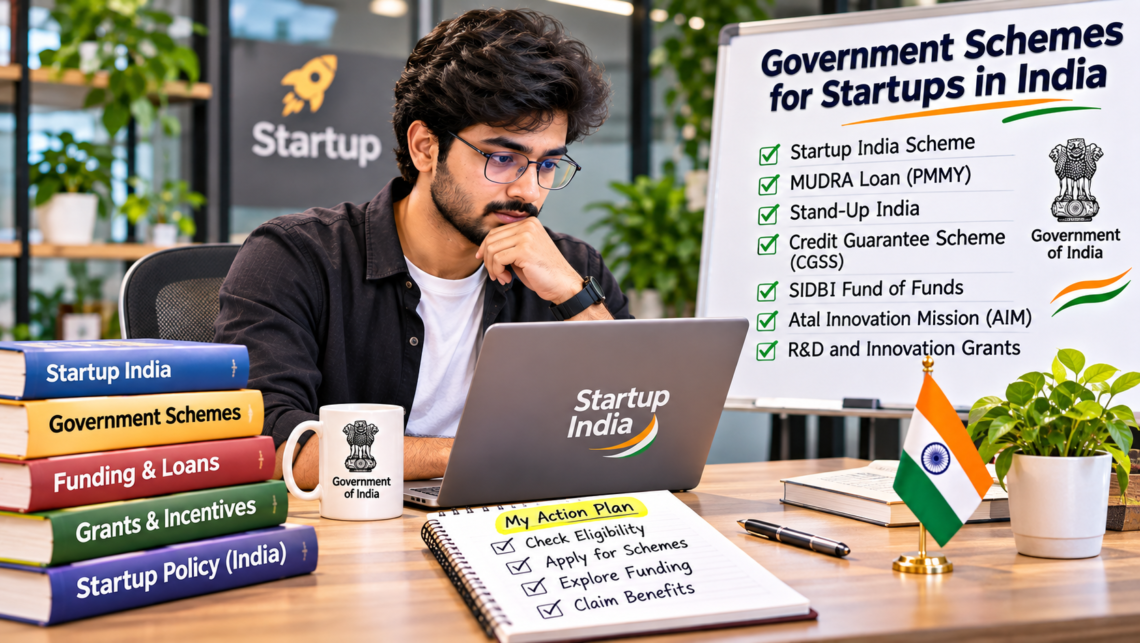
Most founders hear about government schemes for startups in India and then do nothing. The forms look boring, the names are confusing, and a friend once said the money never arrives. That is a costly habit. Several of these schemes offer free capital, tax relief and legal support that no private investor will give you.
Here are seven schemes that actually matter, in plain language.
1. DPIIT recognition: the key that opens the other doors
This is not a scheme with money in it, but almost everything else depends on it. The Department for Promotion of Industry and Internal Trade (DPIIT) recognises eligible startups, and that recognition is the entry ticket for most benefits. Under the revised rules notified in February 2026, a startup is generally treated as recognised for up to 10 years from incorporation, with an annual turnover limit of Rs. 200 crore. Check the latest conditions on the official portal before you apply, because eligibility details get updated.
Do this first: apply on the Startup India portal before you chase anything else.
2. Startup India Seed Fund Scheme (SISFS)
If you are at the idea or prototype stage, this is your best shot. Money comes through approved incubators, with grants of up to Rs. 20 lakh for proof of concept and up to Rs. 50 lakh as debt or convertible debentures for market entry and scaling. DPIIT-recognised startups can apply within two years of incorporation.
Watch out: you apply to an incubator, not directly to the government. A weak application to the wrong incubator wastes months.
3. Credit Guarantee Scheme for Startups (CGSS)
Banks love collateral, and early founders rarely have any. CGSS gives lenders a guarantee, so eligible DPIIT-recognised startups can get loans without putting up property. The cover goes up to Rs. 20 crore per borrower. It is a guarantee for the bank, not free money, so you still need to repay.
4. Fund of Funds for Startups (FFS)
This one works indirectly. The government puts money into SEBI-registered venture funds, and those funds invest in startups. A corpus of Rs. 10,000 crore was set up for this, and a follow-on Fund of Funds 2.0 targets areas like deep tech and manufacturing. You cannot apply to FFS directly. Instead, ask whether the funds you pitch to are backed by it.
5. Section 80-IAC tax holiday
Eligible startups can claim a 100% income tax exemption for three consecutive years within their first ten years, after getting certified by the Inter-Ministerial Board. It only helps once you are making profits, so it is not a lifeline today. But for a business that expects to turn profitable, it is a big win.
6. Support for patents and trademarks
Protecting your idea can be expensive. Under the Scheme for Facilitating Startups Intellectual Property Protection (SIPP), recognised startups get fast-tracked IP applications and help with facilitator costs. If your product depends on a unique process or brand, this saves real money.
7. Easier access to government buying
DPIIT-recognised startups enjoy relaxed norms in public procurement, and platforms such as the GeM Startup Runway help young companies sell to government departments. A single government order can change the first year of a small business, but the paperwork needs patience.
Common mistakes that waste money
- Skipping recognition and then finding out later that every scheme requires it.
- Applying to everything at once with a copy-paste application. Pick two or three that match your stage.
- Missing deadlines because you assumed schemes stay open forever.
- Ignoring the fine print, especially on eligibility and age of the company.
- Trusting agents who promise guaranteed grants. No one can guarantee approval, and you should never pay to “secure” a government scheme.
How to choose where to start
A quick guide by stage:
- Idea or prototype: DPIIT recognition, then SISFS through an incubator
- Early revenue and needing a loan: CGSS through your bank
- Raising equity: pitch funds that are backed by FFS
- Protecting your product: the IP support scheme
- Selling to government: GeM Startup Runway
Schemes, limits and conditions change from time to time, so always confirm details on the official Startup India portal before applying.
Build your network before you apply
Schemes are far easier when you know someone who has been through the process. Other founders can tell you which incubator was helpful, which bank said yes and which form kept bouncing back. That is the kind of practical help you get from a founder community like YBF – Your Best Friend, where Indian founders share what actually worked. You can also read more founder guides on the YBF fan page blog.
Final word
Government support will not run your startup for you, but it can cover the gaps that hurt most in the early days: money, collateral, IP costs and first customers. Start with recognition, choose one or two schemes that fit your stage, and ask other founders for advice before you submit.