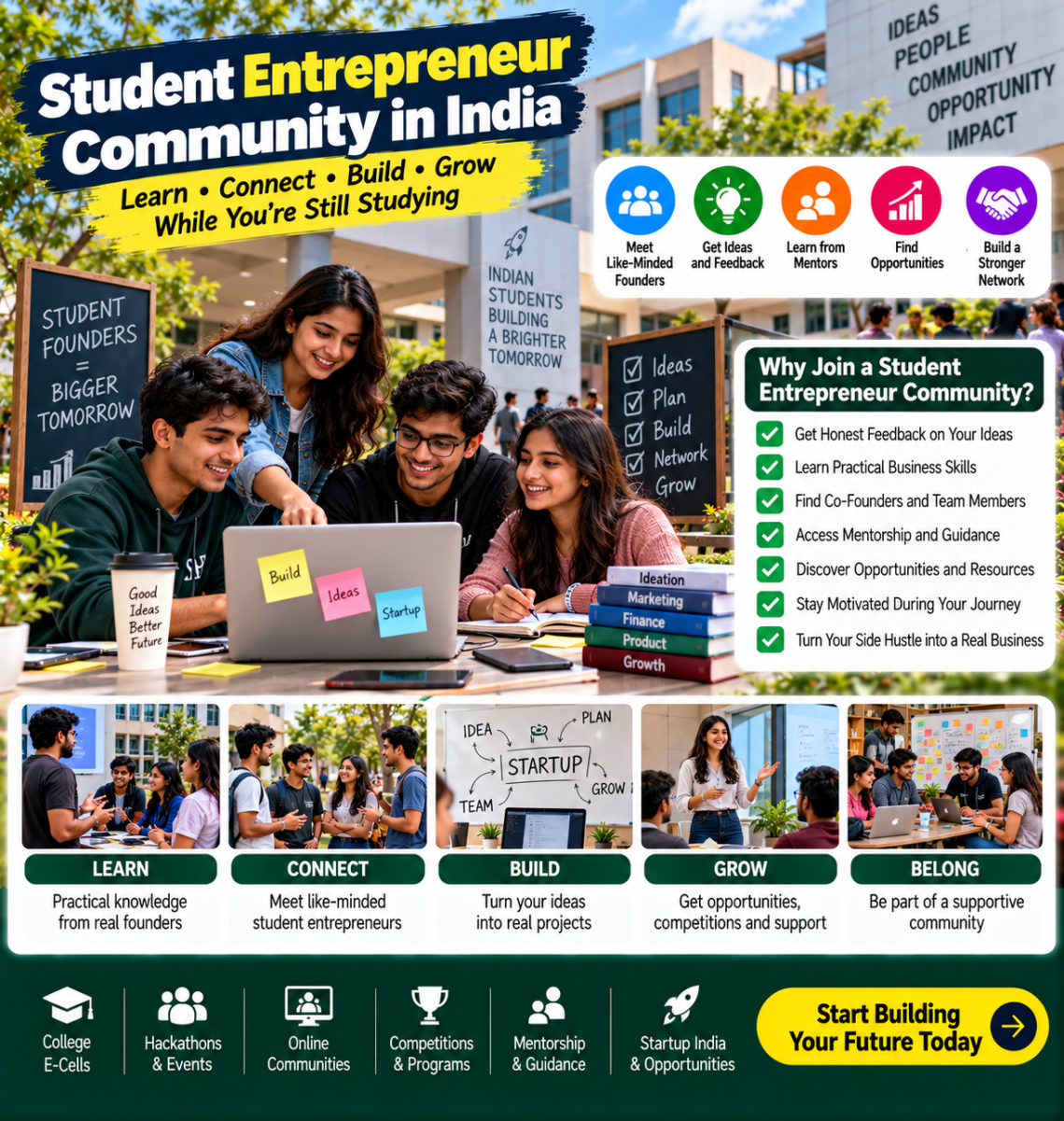
Somewhere in a hostel room, a student is reselling thrifted clothes on Instagram. Another is coding a small app between lectures. A third is running a notes-sharing business from a college canteen table. None of them think of it as a “startup” yet. If you’re one of them, a student entrepreneur community in India can turn a side hustle into something real, and save you from learning every lesson the slow way.
Why Students Need a Community More Than Anyone
Student founders have advantages: time, energy, low expenses and nothing to lose. They also have gaps. No spare money, little business experience, no network and often doubts from family about whether this is a good use of study time.
A community helps with exactly those gaps:
- Credibility. Being around other student builders makes the idea feel normal, not a distraction.
- Ideas and feedback. Classmates may be polite. Fellow founders are more honest.
- Practical know-how. Pricing, first customers, basic registration and money handling.
- Team-building. Many student co-founders meet through shared communities.
- Motivation. Exams and assignments pull your attention. Peers help you keep going.
What You Can Actually Learn
How to find your first customers. Not through ads, but through friends, hostels, college groups and WhatsApp communities.
How to price. Students often undercharge from nervousness. Others have been through it and can guide you.
How to balance studies and business. Setting weekly limits, picking quieter semesters for launches and saying no to extra work.
How to build a small team. Dividing roles, handling disagreements and keeping friendships intact.
How to handle money basics. Tracking income, keeping personal and business money separate and understanding what you need to register as you grow. Talk to a chartered accountant or a trusted mentor when things get serious.
Where Student Entrepreneurs Find Community
- College E-Cells and incubators. Many campuses run entrepreneurship cells that organise talks, competitions and mentorship.
- Hackathons and startup weekends. Quick ways to meet builders and test ideas.
- Online founder communities. Open to students across cities, not just your campus.
- Business-plan and pitch competitions. Good for feedback and sometimes small prizes.
- Social media groups. LinkedIn, X, Discord and WhatsApp groups focused on young founders.
- Government and institutional programmes. Initiatives such as Startup India offer information and resources. Check the current eligibility and schemes before applying.
How to Get the Most Out of Joining
- Introduce yourself with something real. “I’m building a tiffin-subscription service for hostel students, with 25 regular customers” says far more than “I’m interested in startups.”
- Ask specific questions. “How do I find my first ten customers?” gets generic replies. “How did you sell your first product on a campus with no marketing budget?” gets real stories.
- Offer something back. Students often know trends, social media habits and Gen Z tastes better than older founders do.
- Start small and ship. A tiny working version teaches more than a long plan.
- Be patient with yourself. Most first ideas change. That’s normal.
Mistakes to Avoid
- Quitting studies in a rush because of a good week
- Spending savings or borrowed money on an untested idea
- Ignoring family concerns instead of explaining your plan
- Joining ten groups and engaging with none
- Chasing funding before getting any customers
- Copying a trending idea without understanding the customer
Balancing Studies and Business
Your degree and your business aren’t enemies, but both need time. Plan your week with fixed study hours. Pick lighter business weeks around exams. Tell mentors and co-founders your constraints honestly. A community of other student founders understands this balance in a way many adults don’t.
A Word for Parents and Mentors
Many parents worry that entrepreneurship will hurt grades. A good community can reassure them by showing that most student founders stay in college, learn practical skills and treat the business as a learning project first and an income source second. Encourage safe, small experiments and open conversations about money.
Finding Your Circle
If you want to meet entrepreneurs at different stages, YBF (Your Best Friend) is a community for Indian founders where questions get honest answers. You can also read more guides for young founders on our resource page.
Final Thought
Being a student is one of the best times to try building something. Risks are small, time is flexible and mistakes are cheap. Join a community that takes young founders seriously, ask real questions and keep your first projects small. Whatever happens to the idea, the skills and friendships you build will stay with you.