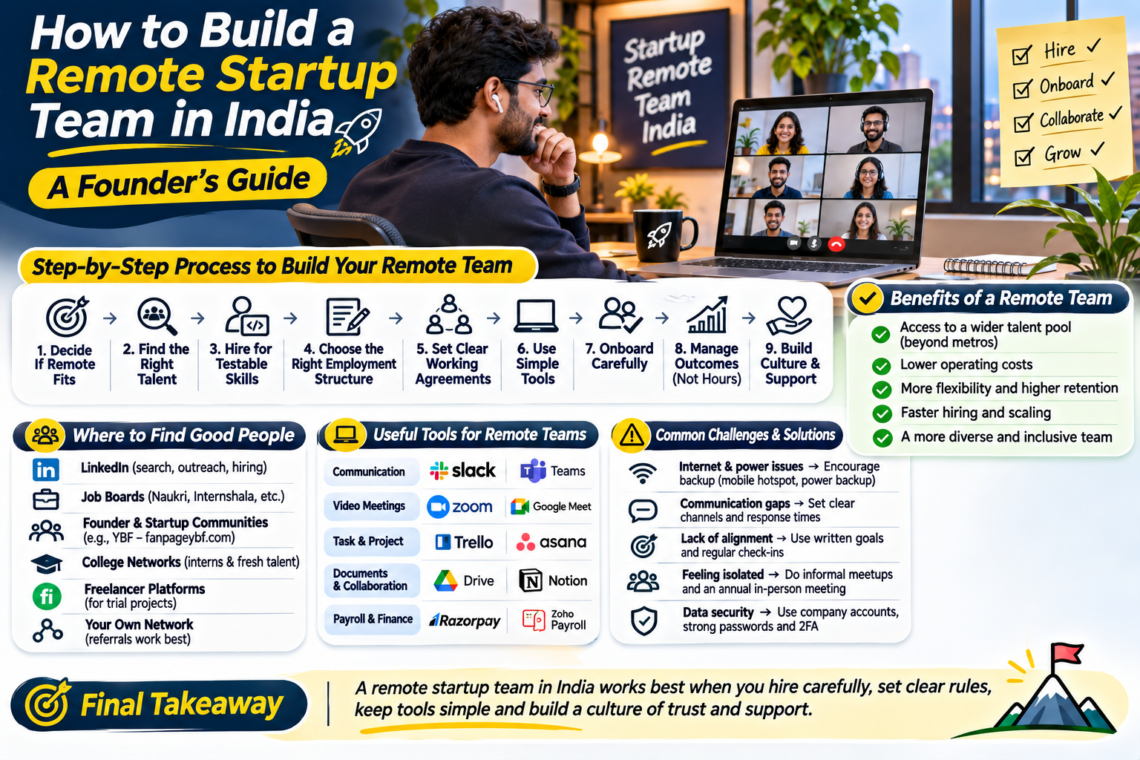
Ten years ago, a startup in India usually meant a small office, a few desks and a team that sat within shouting distance. Today, many founders hire people across cities, and some never rent an office at all. Remote work lets you hire talent beyond your own city, keep costs low and give people flexibility. But it also exposes weak habits quickly. If you are working out how to build a remote startup team in India, this guide covers where to find people, how to set the team up and what to watch out for.
Decide If Remote Fits Your Startup
Remote work does not suit every business. Software, design, content, marketing, customer support and many services work well online. Businesses that involve physical products, local fieldwork or constant hands-on collaboration may need a hybrid model, with a small core team in one place. Be honest about your own style too. If you rely on quick, informal chats to run the company, you will have to learn to write things down and plan ahead. Many founders start with a hybrid setup and move further towards remote as the team grows.
Where to Find Good People
One of the biggest advantages of remote hiring in India is the pool of talent outside the big metros. Capable developers, designers, writers and operators live in smaller cities and towns, and many prefer to work for a startup without moving. Start with your own network, since recommendations from people you trust reduce risk. Founder communities and groups are useful for this, and our guide to the startup founder community in India explains how to find them. Job boards, LinkedIn and college networks also help, as do freelancer platforms for trial projects.
Hire for Skills You Can Test
You cannot read body language in a video call the way you can in an office, so test real work. Give candidates a small, paid task that mirrors the job, such as building a simple feature, writing a short piece or solving a customer problem. Watch how they communicate, whether they ask good questions and whether they meet the deadline. Look for self-starters, people who are clear in writing and comfortable asking for help. Technical skill matters, but in a remote team, reliability and communication matter just as much.
Choose the Right Employment Structure
Decide whether each person is an employee, a contractor or a freelancer, because the legal and tax treatment is different. Employees come with offer letters, salary slips, and obligations such as provident fund and state insurance when thresholds are met, along with local rules that depend on the state where the person works. Contractors are paid for deliverables and handle their own taxes, but you must still deduct tax where the law requires it. Misclassifying someone to save money can cause problems later. Labour rules in India are changing, so check the current position on the Ministry of Labour and Employment website and speak to a chartered accountant or labour lawyer. If you are still setting up your company, our guide on how to register a startup in India is a good starting point.
Set Clear Working Agreements
Remote teams function on clarity. Write down working hours or at least the hours when people must be reachable, how quickly messages should be answered and which channels are used for what. For example, decide that urgent matters go on a call, routine updates go on a team chat and decisions go into a shared document. Define who makes which decisions. Put goals in writing, with deadlines and owners. When everyone knows what is expected, there is far less need for constant check-ins.
Pick Simple Tools
You do not need many tools. A group chat app for daily talk, a video call tool for meetings, a shared drive for documents and a task board to track work will cover most teams. Add an accounting and payroll tool as you grow. Resist the urge to add more software every month, because each tool adds friction. Agree on one place where tasks live and one place where decisions are recorded, and make everyone use them.
Communicate in Writing and Run Light Meetings
Remote teams that communicate mostly in writing tend to run smoother. Written updates let people in different cities and with different schedules stay informed without waiting for a call. Ask team members to post a short update each day or week on what they finished, what is next and where they are stuck. Keep meetings short and purposeful. A weekly team meeting, a regular one-to-one with each person and a monthly review of goals are enough for most startups. Record key decisions so people who miss a call can catch up.
Onboard Carefully
The first weeks decide whether a remote hire succeeds. Send equipment or setup instructions in advance, give access to tools before day one and prepare a simple onboarding plan that covers the company’s goals, customers, products and the first tasks. Assign a buddy who can answer small questions, since new people often feel shy about interrupting a founder. Check in often in the first month and ask what is unclear.
Manage Outcomes, Not Hours
Micromanaging a remote team kills trust. Focus on results: did the work get done, was it good and was it on time? Give feedback regularly and specifically, and praise good work openly. If performance slips, speak to the person early and ask what is blocking them, whether it is unclear instructions, a bad internet connection or personal pressure. Many problems in remote teams come from poor setup rather than poor effort.
Practical Issues in India
Do not ignore infrastructure. Power cuts and unstable broadband are real in many places, so ask team members about backup options and agree on how to handle outages. Keep data secure by using company accounts, strong passwords and two-factor authentication. Make sure laptops and files have basic protection, especially if customer data is involved. Plan payments reliably and on time, since salary delays hurt trust faster in a remote team.
Build Culture and Care for People
Remote work can feel lonely. Create small rituals, such as a weekly informal call, shared wins in the group chat and an annual in-person meet-up if the budget allows. Meeting in person even once a year makes online work easier afterwards. Watch for signs of overwork, because people who work from home often struggle to stop. Our article on founder burnout and how to avoid it shares habits that apply to teams as well.
Final Thoughts
A remote startup team can be faster, cheaper and more flexible than an office-based one, but only if you build it on clarity, trust and good habits. Hire carefully, set the rules in writing, keep tools simple and treat people fairly. If you want to learn from founders who have built distributed teams, you can connect with the community at YBF.