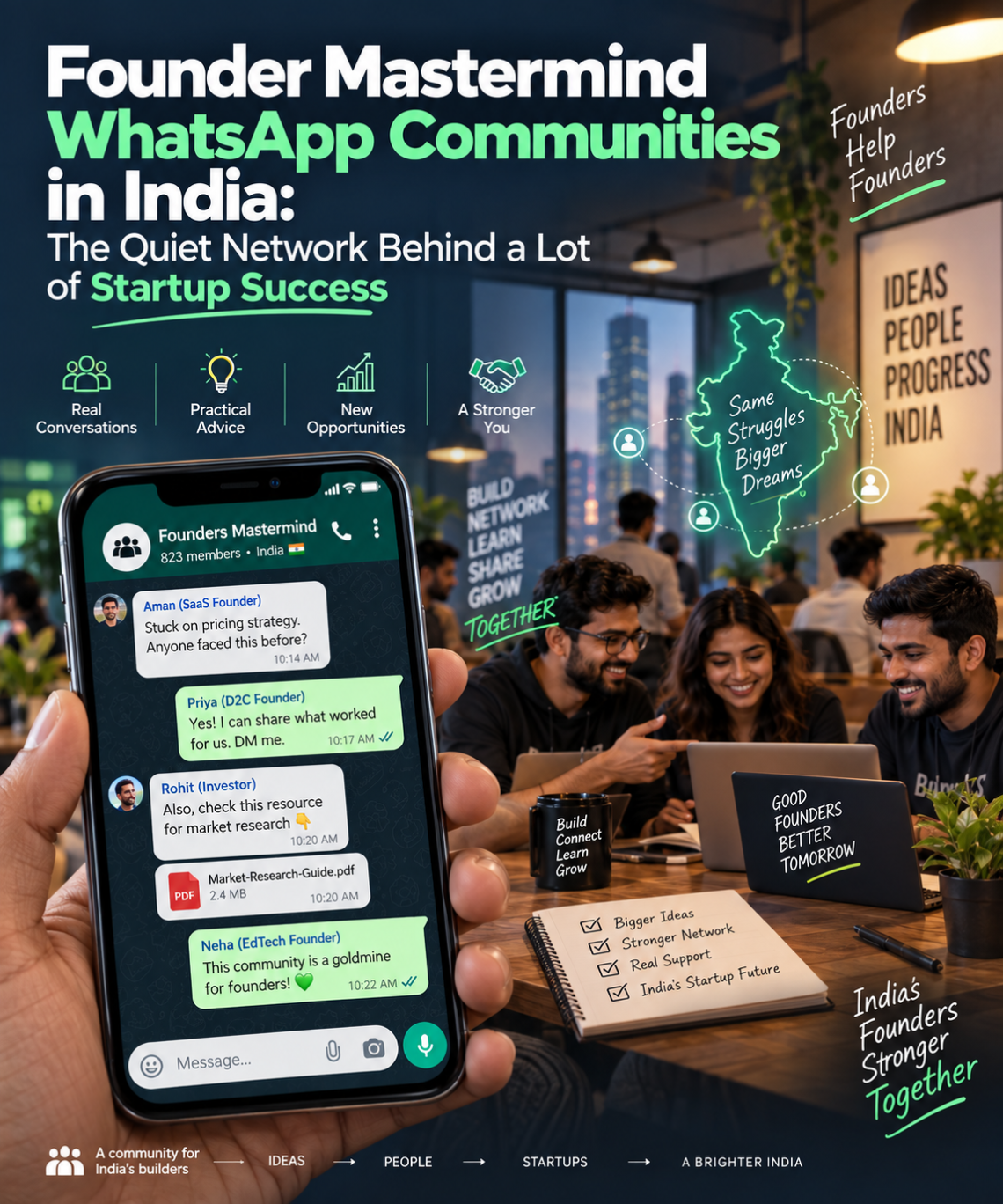
If you’ve spent even a little time around Indian founders, you’ve probably noticed something — the real conversations rarely happen on LinkedIn. They happen in a WhatsApp group at 11 PM, where someone’s asking “has anyone dealt with a GST notice like this” and three people reply within minutes. That’s a founder mastermind WhatsApp community doing exactly what it’s meant to do.
What a Founder Mastermind Group Actually Is
A mastermind, in the founder context, isn’t just a group chat where people say congrats on funding rounds. It’s a curated circle — usually 15 to 100 founders, sometimes organized by stage, sometimes by industry, sometimes by city — where people show up to actually help each other. Someone posts a hiring problem, someone else has solved it last month and shares exactly what worked. Someone’s stuck on pricing, and within the hour there’s a thread of real numbers, not theory.
The WhatsApp format works because it’s low-friction. No app to download separately, no clunky forum login, no algorithm deciding what you see. It’s the tool every founder already checks fifty times a day anyway — so the community lives where the founder already is.
Why India, Specifically, Leans Into WhatsApp
For founders in major startup hubs, a founder community in Mumbai can also provide a more focused way to build meaningful connections beyond a WhatsApp grou. It works on patchy internet, doesn’t need everyone to be tech-savvy, and feels personal in a way a Slack channel with fifty unread messages never quite does. A voice note explaining a tricky compliance issue often communicates more, faster, than a typed-out paragraph would.
There’s also the trust factor. Indian founders — especially first-timers — often hesitate to admit they’re struggling in public spaces like LinkedIn, where everything is curated for appearances. A smaller, WhatsApp-based mastermind feels more private, more like talking to friends than posting for an audience.
What Good Mastermind Communities Actually Deliver
Not every WhatsApp group with “founders” in the name is worth being in. The ones that actually move the needle tend to have a few things in common:
- Active daily conversation, not just occasional broadcast messages from an admin
- A mix of founders at different stages — so a pre-revenue founder can learn from someone who’s already scaled, and vice versa
- Some structure — weekly prompts, themed discussion days, or scheduled calls that pull the group beyond just text
- Real vulnerability allowed — people posting about burnout, cash crunches, co-founder conflict, not just wins
- A connection to offline touchpoints, so the online trust eventually becomes real relationships in person too
The Mentorship Angle
A lot of the value in these communities isn’t peer-to-peer — it’s the founders a few years ahead who show up to answer questions with zero ego and zero pitch involved. That kind of informal mentorship is hard to find anywhere else. Nobody’s charging for a consulting call; it’s just someone who’s been through the exact same problem, choosing to help.
For solo founders especially, this matters more than people expect. Building alone is isolating in ways that don’t show up on a pitch deck. A mastermind group becomes the place where you don’t have to perform confidence — you can just ask the dumb question and get a straight answer.
How to Find (or Build) One That’s Actually Good
If you’re looking to join a founder mastermind WhatsApp community in India, a few signs it’s worth your time: it has an application or vetting step (open-to-all groups tend to get noisy and low-trust fast), the admin is active in moderating spam, and there’s a clear reason people are in it beyond just “networking.” The best ones usually sit inside a larger founder community structure — one that also runs offline meetups and mentorship sessions — so the WhatsApp group is just one layer of a much deeper support system, not the whole thing.
Final Thought
A good founder mastermind WhatsApp community won’t show up in a funding announcement or a press release. But ask any founder who’s actually built something meaningful, and there’s a good chance a group chat full of people who “get it” was quietly part of how they got through the hardest days.