Women across India are starting businesses in every sector, from handmade products and food brands to software, finance and manufacturing. Many of them describe the same experience: they have a good idea, the skills to build it, and then they find themselves looking for people who understand their situation. Some do not have a network of other founders. Some find that investor and industry rooms feel unwelcoming. A women founders community India offers can fill that gap. This guide explains what these communities do, how to choose one and how to get real value from it.
Why a Dedicated Community Helps
A general founder group is useful, but a women-focused one adds something specific. Members often share practical experiences that are hard to find elsewhere, such as how to handle fundraising meetings where nobody else looks like you, how to balance work with family expectations, or how to deal with a supplier who will not take you seriously. There is also the simple comfort of being in a room where you do not have to explain yourself. That comfort frees up energy for the actual work, which is building the business.
It is worth saying clearly that a community is not a replacement for skills, planning or funding. It helps most when it supports those things, by giving you access to advice, introductions, customers and peers who can tell you honestly what is working.
What Good Communities Offer
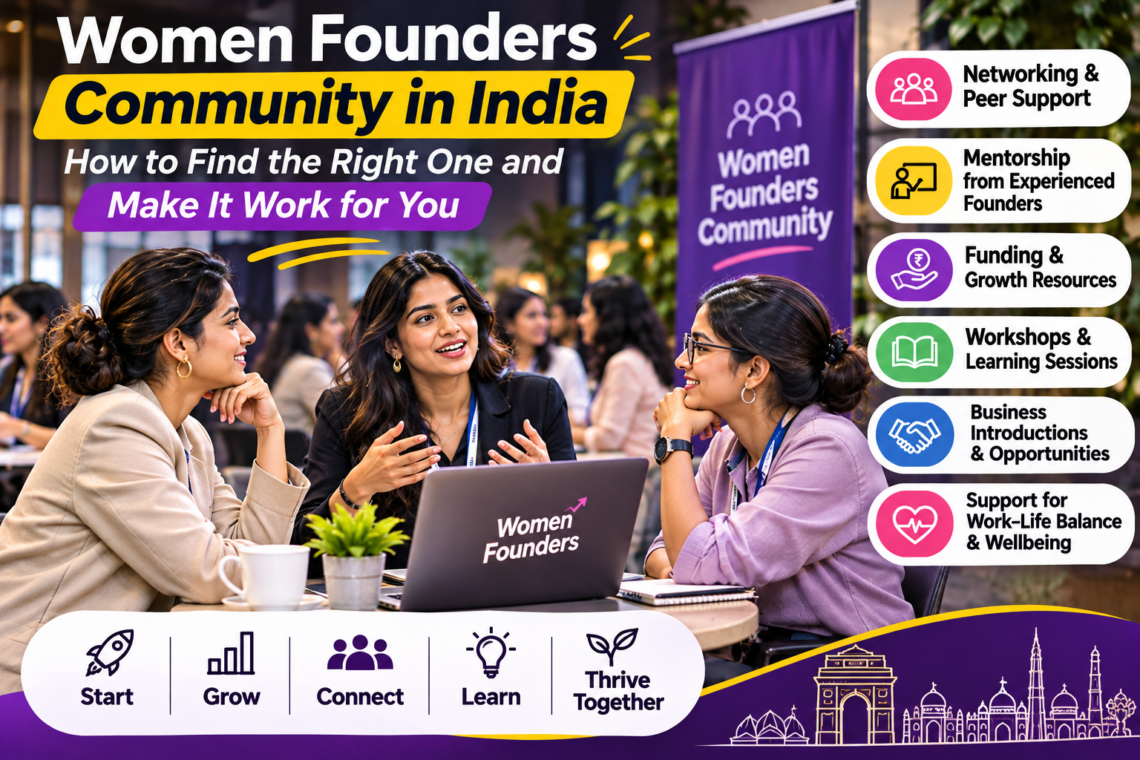
The best groups offer more than a chat group. Look for regular meetups, either in person or online, where members can talk about real business problems. Mentorship is another strong feature, with experienced founders and professionals who give time and guidance. Many communities share information about funding, grants and schemes, and some run workshops on finance, marketing, legal basics and sales. Introductions matter too: a member who knows a supplier, a lawyer or a buyer can save you weeks of searching. Some groups also create spaces for peer support, where founders can talk openly about stress and doubt.
Types of Communities You Will Find
Government-backed initiatives are one option. NITI Aayog’s Women Entrepreneurship Platform is a national platform that brings together resources, networking and information for women entrepreneurs, and several states run their own programmes, such as WE Hub in Telangana, which focuses on women-led startups. Incubators and accelerators sometimes run dedicated tracks for women founders. Industry bodies and chambers of commerce often have women’s wings. Then there are independent communities, both online and offline, run by founders and professionals who want to support each other. Many of these run on WhatsApp, LinkedIn or community platforms, and they can be a good starting point if you want something informal.
How to Choose the Right Community
Start by asking what you need most right now. If you are still working on an idea, a friendly, open group with regular conversation may be enough. If you are looking for customers, choose a community with active business owners and a habit of referring work to each other. If you are preparing to raise money, look for groups with investor access and experienced mentors, but be realistic about timing. Then look at how the community actually runs. Is there a clear purpose and a person responsible for it? Do members speak to each other, or is it mostly announcements? Are events regular and well organised? Ask a current member what changed for them after joining.
Be careful with groups that charge large fees and promise funding or guaranteed clients. Real communities build value slowly, through trust and regular contact.
Get the Most Out of Joining
Joining is only the start. The founders who gain most are those who take part. Introduce yourself clearly, saying what you do and what kind of help would be useful. Answer other people’s questions when you can, because helping others builds a reputation faster than asking alone. Attend meetups, even when you feel busy, since people remember faces more than messages. When someone gives you advice, thank them and tell them what happened. Over time this turns a group of strangers into a circle of people who want you to succeed.
Do Not Rely on One Group
Different communities serve different needs. You might use one group for peer support, another for industry contacts and a third for fundraising advice. You do not need to be active everywhere. Choose one or two where you can give time, and stay light in the rest. Also keep building relationships outside women-focused spaces, because customers, suppliers and investors will come from every kind of room. Our guide to the startup founder community in India explains how to evaluate and use any founder group, and the same principles apply here.
Practical Challenges and How to Handle Them
Many women founders say time is the hardest part, because work and home responsibilities compete. If this is true for you, look for communities that offer flexible timings and online options. Another challenge is access to capital and credit. Ask your community about schemes, banks and grants that are aimed at women entrepreneurs, and check the official sources for current terms before you apply, since details change. Confidence is also real. Many capable founders downplay their own work, and a supportive group can help you practise your pitch, price your services properly and ask for what the business needs.
Starting Your Own Circle
If you cannot find the right group, consider starting a small one. Invite five or six founders from different sectors for a monthly breakfast or video call. Keep it informal, rotate who hosts and agree to speak honestly about what is going well and what is not. Small circles like this often become the most valuable part of a founder’s network, because the trust is deeper.
Final Thoughts
A good community will not build your business for you, but it can shorten your path by connecting you with people who have solved the problems you face. Decide what you need, choose a group with real activity, take part fully and keep building relationships beyond it. If you want to meet founders who are building alongside you, connect with the community at YBF.