Friends say “great idea.” Family says “go for it.” Nobody asks for a rupee. That’s the trap. If you’re trying to work out how to validate a startup idea in India, the goal is simple: find out whether strangers will pay for this, using as little money and time as you can.
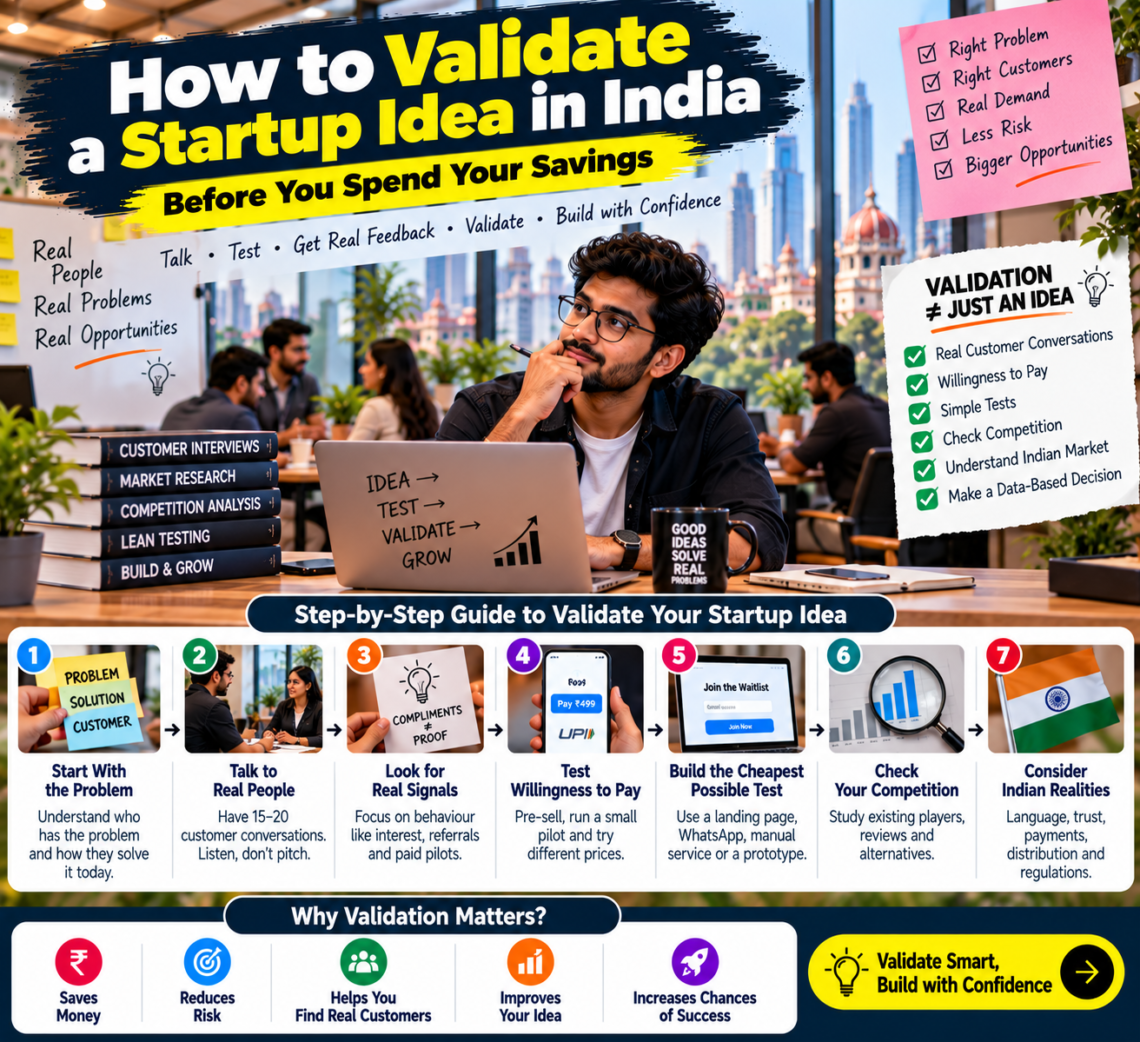
Start With the Problem, Not the Product
Most failed ideas begin with “I want to build X.” Validation begins with “Who has this problem, and how bad is it?”
Write one plain sentence:
“[Specific people] struggle with [specific problem] and currently deal with it by [what they do today].”
For example: “Small clinics in Tier-2 cities lose patients because they manage appointments in paper registers.” If you can’t write the sentence, the idea isn’t ready to test.
Talk to Real People First
Skip surveys for now. Have conversations, fifteen to twenty if you can.
- Find people who match your customer. Not friends who’ll be polite.
- Ask about their past, not your idea. “Tell me about the last time this went wrong.”
- Ask what they do today. The workaround tells you how serious the problem is.
- Ask what it costs them. Time, money or stress.
- Don’t pitch. Listen, take notes and ask “why” a few times.
If people shrug, the pain is probably small. If they lean in and start telling stories, you’ve found something.
Compliments Are Not Proof
“This is interesting” costs nothing. These signals are worth far more:
- They ask when they can use it
- They offer to introduce you to someone else with the same problem
- They agree to a paid pilot
- They give an advance or a deposit
- They come back with follow-up questions
Collect behaviour, not opinions.
Test Willingness to Pay
India is a price-sensitive market, so this step matters a lot.
- Pre-sell. Offer the product before you build it. Even five early buyers tell you plenty.
- Charge a small amount for a pilot. Free users often disappear.
- Try two prices and see how people react.
- Ask directly: “If this worked as I described, would you pay ₹X a month?” Then see if they actually do.
If nobody will pay even a small amount, rethink the idea or the customer.
Build the Cheapest Possible Test
You don’t need an app or a website to start.
- A simple landing page explaining the offer, with a button to join a waitlist or book a call
- A WhatsApp or Instagram test. Share the offer with a small audience and see who replies
- A manual version. Deliver the service yourself with spreadsheets, calls and messages before automating anything
- A prototype or mock-up to show people what it would look like
- A small ad test with a modest budget, only to measure interest
Keep it small. If a test takes three months and a loan, it’s not a test.
Check Your Competition Honestly
If nobody else is solving it, ask why. Sometimes it’s an opportunity, sometimes there’s no real demand.
- Look at existing companies, local players and informal alternatives like WhatsApp groups and Excel sheets
- Read their customer reviews to find complaints
- Ask potential customers why they use or ignore current options
- Be clear about what you’ll do differently
Competition usually proves the problem exists.
Think About Indian Realities
- Language. Your customers may prefer Hindi, Tamil, Telugu or another regional language.
- Trust. Many buyers prefer to pay after seeing results, or want a known name or referral.
- Payments. UPI is widely used, but cash on delivery still matters in many categories.
- Distribution. Reaching customers in smaller towns often needs partnerships, not just ads.
- Regulation. Food, health, finance and education can involve licences or rules. Speak to a qualified adviser before launching in a regulated area.
- Price sensitivity. Low willingness to pay may mean you need a different model, not a cheaper product.
Decide What “Success” Means Before You Test
Set a clear bar in advance, so you don’t fool yourself later.
- “20 conversations, at least 8 describe this as a major problem”
- “5 people pay for a pilot within one month”
- “100 signups from a targeted post, with 10 booking a call”
Choose numbers that fit your idea. If you miss the bar, change something and test again, or stop.
Common Mistakes
- Asking friends and family only
- Describing the solution before understanding the problem
- Building a full product first
- Counting likes, shares or waitlist signups as demand
- Ignoring early warning signs because you’re attached to the idea
- Testing with too few people
- Changing the question halfway, so the results can’t be compared
What to Do With the Results
- Strong signals: Keep going, build a small version and charge for it.
- Mixed signals: Narrow the customer or the problem and test again.
- Weak signals: Don’t take it personally. Change the idea or move on. You’ve saved yourself months.
Each round teaches you something, even if the answer is no.
Talk It Through With Other Founders
Validation feels less lonely and less biased when you can test your thinking with people who’ve been through it. YBF (Your Best Friend) is a community for Indian entrepreneurs where founders trade honest feedback on ideas and early experiments. You can also read more founder guides on our resource page.
Final Thought
Validation isn’t about proving you’re right. It’s about finding out quickly and cheaply whether real people will pay for what you want to build. Talk to customers, test with small experiments and trust behaviour over compliments. That’s how a first idea becomes a business, or saves you from an expensive mistake.